


How Do You Tell If a Jazz Record Is an Original Pressing?
Last Updated: October 28, 2026
Quick Summary
An original pressing is a record made from the first masters and stampers for an album, usually when it first came out. To identify one, compare the catalog number, label design, dead-wax matrix numbers, and sleeve, and check that they agree with each other and with a reliable discography.
- Check that the catalog number matches on the spine, front cover, and label.
- Compare label logo, address, and copyright text with the release year.
- Read matrix numbers in the dead wax under bright, angled light.
- Call it a first pressing only when the strong clues all agree.
Table of Contents
- What an Original Pressing Is and Why It Matters
- Original Pressings Versus Reissues: The Core Differences
- How to Tell If a Vinyl Record Is a First Pressing
- Reading Deadwax and Matrix Numbers on Jazz Records
- Checking Jazz Label Variations and Logos
- A Step-by-Step Verification Workflow for Each Release
- Weighing Conflicting Clues and Counterfeit Risks
- Booking Your Next Jazz Crate Check With Vyle Vinyl
- Frequently Asked Questions
Jazz records can sell for many times the price of a later reissue, and the difference often comes down to a few small marks in the run-out groove and on the label.
Identifying an original pressing is part detective work and part patience. No single clue settles the question. You look at the label, the catalog number, the matrix numbers etched in the dead wax, and the sleeve, then check whether they agree with each other.
What an Original Pressing Is and Why It Matters
An original pressing is a record made from the first set of masters and stampers for an album, usually released when the record first came out.
Later copies come from the same master tapes but use newer stampers, new labels, or new sleeves. Some are faithful reissues. Others are cheaper repackaging. Knowing which you have changes what the record is worth and how you should treat it.
Original Pressings Versus Reissues: The Core Differences
The clearest way to tell them apart is to compare what the record says about itself. Original pressings usually carry:
- A label design that matches the label's era, with the original address and copyright line
- A catalog number that matches the release date
- Matrix or stamper marks in the dead wax that fit an early run
Reissues often show:
- A newer label design or a modern logo added to an old design
- Updated address or copyright text
- Matrix numbers that run past the original sequence
Do not rely on any one of these. A reissue can copy an original label closely, so you need to check several features together.
How to Tell If a Vinyl Record Is a First Pressing
The word "original" gets used loosely, and that looseness costs collectors money. Before you check a single mark, separate the terms:
- First pressing: the earliest run manufactured from the first stampers for a release, before any stamper, label, or sleeve change.
- Contemporaneous pressing: made at roughly the same time as the first run, often at a different plant or for a different market, from the same masters. It is early and legitimate, but it is not the first pressing.
- Repress: a later run from the same masters, usually with new stampers. The label may be identical; the dead wax usually is not.
A record can be an original release and still not be a first pressing. That distinction is where most misdescriptions happen.
The Four-Clue Check
Run these four checks on every candidate, in this order, and write down what you find:
- Catalog number, read it from the spine, the front cover, and the label. All three should agree. A mismatch between cover and label is a warning sign.
- Label design, logo, address, copyright text, and label ring should match the era your discography assigns to that catalog number.
- Dead wax, record the matrix number, any stamper or mother codes, and any hand-etched initials. Compare the sequence against documented early runs.
- Sleeve and cover, back-cover text, printing quality, and any catalog or price text should be consistent with the first issue, not a later repackaging.
Weighting the Evidence
Not all clues are equal. A workable hierarchy:
- Strongest: dead-wax matrix and stamper codes that match a documented first run, combined with a label that matches the same era.
- Strong: a label design and address that a labelography places in the correct year range.
- Moderate: sleeve and cover printing details, which can be swapped between copies.
A common pattern among experienced collectors is to require the strong clues to agree before using the word "first pressing" in a listing. If only moderate or weak clues line up, describe the record as an early pressing and say why.
When the Clues Conflict
Conflicts are normal, and they usually mean one of three things:
- A married copy: the record and jacket came from different copies. Check that the inner sleeve, cover printing, and label all belong to the same release.
- A later pressing with an early-looking label: some represses reused label artwork. The dead wax is your tiebreaker.
- A genuine transitional copy: labels sometimes used up old stock during a design change. A discography that documents the transition will tell you whether the combination is known.
If the dead wax points late but the label and sleeve look early, do not average the clues into a verdict. Identify which component is the outlier and describe the record by its weakest confirmed feature.
A Quick Decision Rule
Call it a first pressing only when the catalog number, label era, and dead-wax sequence all agree and the sleeve is consistent. Call it an early pressing when the label and sleeve agree but the dead wax is undocumented. Call it a later pressing or reissue when any strong clue points past the first run. When you genuinely cannot tell, say so, "possibly original, unverified dead wax" is an honest listing and protects both sides of the sale.
Reading Deadwax and Matrix Numbers on Jazz Records
The dead wax is the smooth area between the last groove and the label. Pressing details are often etched or stamped there.
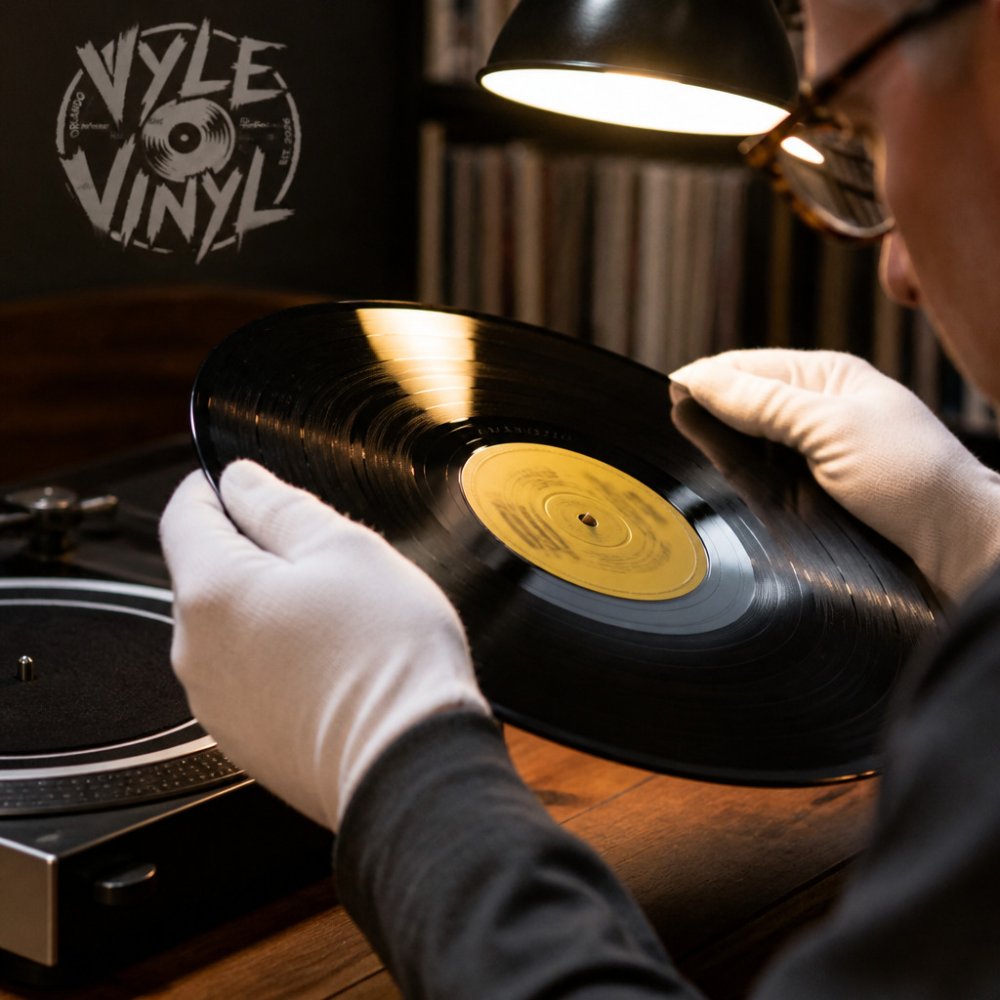
Hold the record under a bright, angled light so the etching catches the shadow.
Compare what you see with a reference discography.
Cannonball Adderley - Something Else →
The dead wax is the smooth area between the last groove and the label, and the key checks are summarised below.
| Check | What to look for | Why it matters |
|---|---|---|
| Dead wax position | Smooth area between last groove and label | Where pressing details are etched or stamped |
| Lighting | Bright, angled light | Makes etching catch the shadow |
| Matrix number | Short code followed by letters and numbers | Compare against a reference discography |
| Handwritten marks | Cutting engineer or stamper initials | Helps date the pressing |
| Unfamiliar sequence | Matrix pattern not in reference | Suggests a later pressing |
Checking Jazz Label Variations and Logos
Jazz labels redesigned their labels constantly, and those redesigns are the single most useful dating tool a collector has. The generic advice, "check the logo, then the address", is fine as far as it goes, but jazz rewards knowing the actual sequences. Below are documented patterns from three labels that dominate original-pressing questions. Treat each as a starting point to verify against a discography, not as a substitute for one.
Blue Note (New York, then Los Angeles)
Blue Note's label history is unusually well documented, which makes it a good training ground:
- Early 1500 series (early 1950s): Deep-groove labels, often with the address printed as a New York address and the famous note-and-microphone logo. The deep groove itself, a raised ring pressed into the label area, is a strong early indicator on many labels of this era.
- Transitional period (mid-to-late 1950s): The deep groove disappears on many releases, and the address text changes as the company relocated. A copy with a New York address on a title that a discography dates to the Los Angeles era is a red flag.
- Later 1500 and 4000 series: Newer label designs, different typefaces, and revised copyright lines. The 4000 series in particular is heavily reissued, so label design alone will not settle it, you need the dead wax.
A practical rule: on Blue Note, the combination of deep groove, address text, and label logo style should all point to the same era. If two agree and one does not, dig further before calling it original.
Prestige (Bergenfield, New Jersey)
Prestige is a trap for beginners because the same catalog numbers were reissued for decades under different corporate ownership:
- Original-era labels typically carry the Prestige name with an address consistent with the period a discography assigns to that catalog number.
- Later corporate-era labels often add new corporate text, revised addresses, or a different logo treatment. These are legitimate pressings, but they are not first pressings.
- The catalog number itself is not proof. A Prestige catalog number can appear on an original, an early repress, and a much later reissue. The label text and dead wax are what separate them.
Riverside (New York)
Riverside's label designs shifted with its address and with its ownership changes. Early labels show simpler typography and older address text; later labels add revised credits and different logo treatments. Because Riverside titles were reissued heavily, compare the label against reference images for the specific catalog number rather than against Riverside labels in general.
Reading the Label in Order
Work through the label in a fixed sequence so you do not anchor on the first thing you notice:
- Logo style, does it match the era your discography assigns to the catalog number?
- Address line, does the city and street match that era?
- Copyright and credit text, are there credits that only appear on later pressings?
- Label ring, is there a deep groove, and does its presence fit the era?
- Typeface and layout, do the fonts and spacing match reference images for this exact release?
Photograph the label straight-on with even lighting and compare it side by side with a reference image at the same scale. Small typeface and spacing differences are easy to miss by eye but obvious in an overlay.
Telling Early Variants From Later Ones
Early variants usually have simpler typography and older addresses. Later variants often add new credits, new logos, or updated print. Some early variants show small errors or inconsistencies that later copies corrected. Treat those oddities as evidence, not as defects, a misspelling that a discography documents on the first run is a positive clue, while a "corrected" version of that same text points to a later pressing.
Blue Note labelography and catalog reference
A Step-by-Step Verification Workflow for Each Release
Use this routine for every jazz record you check:
- Record the catalog number, label, and release year from the spine and front cover.
- Look up the release in a reliable discography and note the expected label design and matrix pattern.
- Examine the label for the logo, address, and copyright text that match your release year.
- Read the dead wax under angled light and write down any etched or stamped marks.
- Compare the sleeve with reference photos, paying attention to the back cover text and printing.
- Score your clues. Mark each feature as consistent, inconsistent, or unknown.
- Decide. Call the record an original pressing only if most clues agree. Note any uncertainty.
Keeping a simple log for each record helps you spot patterns across a collection.
Weighing Conflicting Clues and Counterfeit Risks
Sometimes the clues disagree.
Counterfeits and altered sleeves exist. Some sellers put an original record in a reissue jacket, or reprint a sleeve to look older.
Keep condition, value, and provenance separate from identity. A record can be an original pressing and still be scratched or worth less than expected.
If the clues still conflict after careful checking, describe the record as "possibly original" when you list or sell it.
Booking Your Next Jazz Crate Check With Vyle Vinyl
Search our current jazz selection to see how our records are listed.
Frequently Asked Questions
How can you tell if a jazz LP is an original pressing?
Start with the label design, the catalog number, and the deadwax. Original jazz pressings often carry label designs, address lines, and plant stamps that changed when the label reissued the title. Compare the catalog number against a trusted discography and check whether the matrix numbers in the runout match the original session's release. No single clue settles the question, so cross-reference at least three details before deciding. Keep notes on each record you check so you can compare later copies side by side.
What is the difference between an original jazz pressing and a reissue?
An original pressing is the first release of a recording, made from the original master and stampers. A reissue is a later release of the same music, often with a changed label design, new catalog number, updated credits, or a different pressing plant. Reissues can sound excellent, but they usually carry different identifiers. Check the release date printed on the sleeve, the catalog prefix, and the deadwax to see which version you are holding.
What information in the deadwax helps identify a jazz record pressing?
Deadwax is the smooth area between the last groove and the label. It often holds hand-etched or stamped matrix numbers, mastering engineer initials, and sometimes plant codes. Matrix numbers that match an established discography entry are strong evidence of an original pressing. Record the exact characters, including spacing and any stray marks, because small differences separate early variants from later runs.
How can you tell whether a jazz vinyl record is rare?
Rarity depends on the specific pressing, not only the title. Look for early label variants, limited runs, and identifiers that appear in collector discographies. Condition, provenance, and demand affect what a record is worth, so keep those judgments separate from pressing identity. A record can be an original pressing and still be common, and a later reissue can be scarce. Use recent sold listings and reference guides to gauge the market for the exact variant you have.
