


How to Identify Original Hardcore Punk Pressings?
Last Updated: October 25, 2026
Quick Summary
To identify original hardcore punk pressings, examine the runout markings for stamped versus handwritten codes, verify the catalog number against label-specific formats on Discogs, and compare label design, sleeve materials, and printing quality against documented originals. Original 1980s pressings show era-appropriate imperfections, handwritten plant markings, and thinner paper stock, while reissues typically feature modern barcodes, perfect printing, and updated label designs.
- Original 1980s hardcore pressings were typically pressed in runs of 500 to 2,000 copies, while reissues from the 2000s onward often pressed 3,000 to 5,000 or more.
- Handwritten markings in the deadwax are common on original pressings from underground plants; reissues typically show only stamped markings.
- SST, Dischord, and Touch and Go all modified their label designs over time, so match the specific design to the era of the release.
- Originals rarely had barcodes; reissues almost always do, making barcode presence a reliable reissue indicator.
- Plant codes in the runout are often more decisive than catalog numbers for separating originals from later pressings.
Table of Contents
- Why Original Hardcore Punk Pressings Matter to Collectors
- Reading Runout and Matrix Numbers on Your Vinyl Record
- Using Record Label Catalog Number Lookup to Verify Pressings
- Original Pressing vs Reissue Vinyl: Key Differences
- How to Identify Bootleg Punk Records
- Hardcore Punk Label- and Era-Specific Identification
- Building Your Verification Toolkit
- Frequently Asked Questions
Why Original Hardcore Punk Pressings Matter to Collectors
Learning how to identify original hardcore punk pressings separates serious collectors from casual listeners.
At Vyle Vinyl, we've spent years helping collectors authenticate their finds. The difference between an original and a reissue often comes down to details most people miss: runout numbers, label variations, sleeve materials, and catalog number placement.
This guide covers the concrete steps to verify an original pressing: matrix codes, deadwax markings, label design, and era-specific clues.
Reading Runout and Matrix Numbers on Your Vinyl Record
The runout groove, or deadwax, holds critical information etched or stamped into the vinyl near the center label, your first stop for pressing verification.
Finding the deadwax area near the label
Flip your record over and examine the ungrooved area between the music and the label, marked with numbers, letters, or symbols pressed or handwritten into the vinyl.
Here's what to look for:
- Stamped markings appear raised or indented into the vinyl during pressing
- Handwritten markings look like someone used a pen or marker on the finished record
- Matrix numbers are typically alphanumeric codes identifying the pressing plant and run
Use a flashlight angled to catch the surface detail. Original pressings often show clean, consistent stamping; reissues may have different fonts, spacing, or clarity.
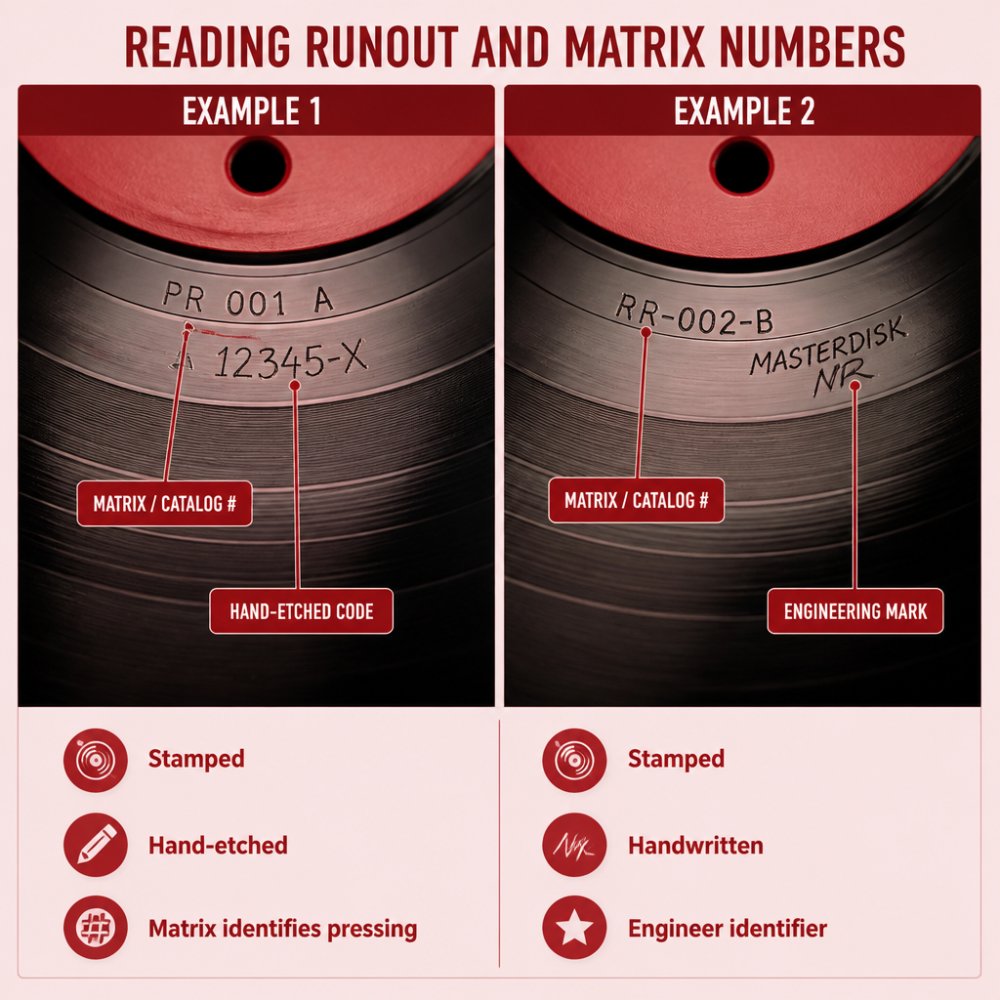
Decoding stamped versus handwritten markings
Stamped markings were made during pressing and appear on every copy from that run.
Reissues typically have only stamped markings, since modern plants rarely add handwritten notes. A record with no handwritten marks but a 1980s-looking label is a red flag.
Compare markings across copies: originals from the same run show similar stamping but vary in handwriting, while reissues show identical markings across all copies.
Using Record Label Catalog Number Lookup to Verify Pressings
The catalog number is your fastest cross-reference, but in hardcore punk it's also the most misread. Scene labels used no consistent numbering, and the same number can appear on an original, a later pressing, and a foreign license pressing. Knowing each label's format tells you what a catalog number can and cannot prove.
Where the catalog number appears
Check four places and write down each version exactly as printed:
- Spine, usually the cleanest, most legible printing
- Back cover, often near the barcode area or lower corner
- Center label, printed on both sides, sometimes with a side suffix (A/B, 1/2)
Discrepancies between these four locations are evidence, a sleeve printed with one number and a label with another often indicates a repress reusing old cover stock, or a plant mismatch.
Hardcore catalog-number conventions by label
Hardcore collectors need label-specific formats, not just "find the number and search it":
-
SST Records, early releases used a simple
SST-prefix with a sequential number (e.g., SST-001 through the low hundreds). Later SST pressings sometimes added a second code or changed the prefix format, so an SST number alone does not date a copy; the runout plant code does more work. -
Dischord Records, the
DISprefix with a sequential number is the anchor. Early Dischord releases were pressed in small batches and re-cut multiple times, so the sameDISnumber can cover several distinct pressings. The catalog number identifies the release; the runout identifies the pressing. -
Touch and Go Records,
TGprefix with a number. Touch and Go reissued much of its own catalog, so aTGnumber is common to both original and reissue; the label design and runout are what separate them.
A catalog number that matches a known release but not the label's era convention is a warning sign.
Reading a database entry correctly
Discogs pressing database is the most complete public reference, but most collectors misread it. A single release page can list dozens of "versions," each with its own pressing details. Work through the fields in this order:
- Release vs. master, the master page groups all versions; the release page describes one specific pressing. Always confirm you are on a release page, not the master.
- Country, a US original and a European license pressing can share a catalog number. Match the country field to where the record was actually made.
- Pressed By / Manufactured By, this is where plant codes live. Compare the plant listed against the plant code in your runout.
- Matrix/Runout field, the database transcribes runout strings exactly. Compare character by character, including spaces and slashes.
- Notes and BaOI, the "Barcode and Other Identifiers" section often contains the detail that separates an original from a later pressing.
When the catalog number does not match
If your number appears in no database entry, don't assume bootleg. Common innocent explanations include:
- A promotional or pressing-plant variant that was never widely documented
- A foreign license pressing with a locally assigned number
- A test pressing with a handwritten or blank catalog area
Cross-reference against MusicBrainz release data as a second source, and check collector forums for the specific label. A number that appears nowhere is a reason to slow down, not a verdict.
Original Pressing vs Reissue Vinyl: Key Differences
The core distinction is timing: an original was pressed during or shortly after the album's initial release; a reissue came later, sometimes decades afterward.
1980s hardcore originals were typically pressed in runs of 500 to 2,000 copies; reissues from the 2000s onward often pressed 3,000 to 5,000 or more. Higher pressing numbers suggest a reissue.
Label design and text variations across pressings
Label design changed over time, even for the same album. SST, Dischord, and Touch and Go all modified their designs as they evolved. Originals show the design used at release; reissues use updated designs or recreate the original with modern printing.
Look closely at:
- Font style and size on the label
- Color saturation and printing quality
- Text placement and spacing
Original 1980s labels often show slight imperfections, uneven color, faded text, printing variations, signs of era-appropriate technology. Reissues can look too perfect.
Sleeve and packaging clues
Original pressings used 1980s materials: paper stock feels different from modern cardboard, ink fades differently, and wear patterns reflect age.
Check for:
- Paper grain and texture (original sleeves feel rougher, more natural)
- Ink fade patterns (originals show uneven fading from age and light exposure)
- Printing registration (slight misalignment is common on originals)
Open the gatefold or inner sleeve. Originals sometimes include printed inserts, handwritten notes, or band photos; reissues may add liner notes or updated credits.
Feel the vinyl itself. Originals sometimes have a slightly different texture or weight than modern reissues, not foolproof, but one more data point.
How to Identify Bootleg Punk Records
Bootlegs are unauthorized pressings made without the label's or artist's permission, ranging from obvious fakes to convincing counterfeits. How To Spot Bootleg Records provides detailed guidance on identifying counterfeits.
Bootlegs typically show:
- Misspelled text on labels or sleeves (artist names, song titles, label names)
- Poor printing quality with misaligned colors or blurry text
- Incorrect catalog numbers that don't match any official release
Compare your copy against Discogs bootleg documentation, which flags known counterfeits. Search the artist and album, then look for a "Bootleg" notation in the pressing details.
If the price seems too low for a rare original, it probably is.
Hardcore Punk Label- and Era-Specific Identification
Generic vinyl guides treat every label the same. Hardcore punk rewards label-specific knowledge because the scene's labels had distinct pressing practices, plant relationships, and reissue histories.
SST Records
SST was founded by Greg Ginn and released Black Flag, the Minutemen, Hüsker Dü, and the Descendents. Its catalog spans the late 1970s through the 1990s, and its pressing practices changed over that run.
What to check on an SST copy:
-
Catalog prefix, early releases used the
SST-prefix with low sequential numbers; later pressings sometimes altered the format, so the number alone does not date a copy. - Label design, SST's center-label design evolved across the 1980s. Compare the specific design against documented copies of the same release rather than against SST as a whole.
- Runout plant codes, many SST pressings carry plant identifiers in the deadwax. The plant code is often more decisive than the catalog number.
Dischord Records
Dischord, founded by Ian MacKaye and Jeff Nelson, released Minor Threat, Fugazi, Rites of Spring, and much of the D.C. hardcore catalog. Its DIY ethos carried into pressing: early releases were pressed in small batches, and the label re-cut records multiple times as demand continued.
What to check on a Dischord copy:
-
DIScatalog prefix, the number identifies the release, not the pressing. The sameDISnumber can cover several distinct pressings. - Handwritten runout information, early Dischord pressings frequently carry handwritten markings in the deadwax, a signature of the small-plant, small-batch approach.
- Label minimalism, Dischord's label design was deliberately plain. Reprints that "improve" the label design are a warning sign.
Touch and Go Records
Touch and Go released Big Black, Shellac, the Butthole Surfers, and a wide post-hardcore catalog. The label reissued much of its own catalog, making the TG number a weak identifier on its own.
What to check on a Touch and Go copy:
-
TGprefix, present on both originals and reissues; use it to identify the release, then rely on other clues. - Label design changes, Touch and Go updated its label design over time. Match the design to the era of the specific release.
- Reissue notation, later Touch and Go pressings sometimes note the reissue status on the label or sleeve; check both.
Alternative Tentacles and Death Records
Two more labels worth knowing for hardcore identification:
-
Alternative Tentacles, the
VIRUSprefix is consistent across the 1980s catalog and is a useful dating anchor. Label design and runout plant codes do the rest. - Death Records, a smaller catalog with sequential numbering. Later pressings reused the same numbers with updated label designs, so the label design and runout must be checked together.
We carry examples like D.R.I. - Dealing With It (OG 1985 Death Records pressing) and Black Flag - My War (SST Records), which show authentic original pressing characteristics.


Weighting conflicting evidence
Hardcore pressings frequently produce conflicting clues: an original-era label with a later runout, or a database entry that lists two pressing dates for the same catalog number. Resolve conflicts in this order:
- Physical evidence first. The label design, vinyl feel, sleeve stock, and wear patterns you can hold outweigh any database entry.
- Plant code over catalog number. The pressing-plant identifier in the runout is usually more decisive than the catalog number, because catalog numbers were reused across pressings.
- Multiple sources. Cross-reference Discogs against MusicBrainz and collector forums; no single database is complete for small hardcore labels.
- Consistency across copies. Original pressings show consistent characteristics across multiple copies. A one-off anomaly suggests a reissue, a variant, or an error.
- Document and accept uncertainty. Some pressings are genuinely hard to date. Photograph what you find and note the details; a record can be original without perfect documentation.
Each major hardcore label had distinct pressing practices and design conventions that help identify originals.
| Label | Key Catalog Format | Primary Dating Clue | Reissue Risk |
|---|---|---|---|
| SST Records | SST- prefix with sequential number | Runout plant codes more decisive than catalog number | High; label design evolved across 1980s |
| Dischord Records | DIS prefix with sequential number | Handwritten runout markings common on originals | Moderate; same DIS number covers multiple pressings |
| Touch and Go Records | TG prefix with number | Runout plant codes separate originals from later pressings | High; label reissued much of own catalog |
| Alternative Tentacles | VIRUS prefix with number | VIRUS prefix consistent across 1980s catalog | Low; prefix is reliable dating anchor |
| Death Records | Sequential numbering | Label design and runout checked together | Moderate; later pressings reused same numbers |
Building Your Verification Toolkit
You don't need expensive equipment. A few simple tools make verification much easier.
Keep a notebook or phone notes app for recording catalog numbers, matrix codes, and observations.
Use Discogs as your primary reference database.
Join online collector communities focused on hardcore punk. Forums like Steve Hoffman Music Forums vinyl section host experienced collectors who answer identification questions and share pressing knowledge.
The more pressings you examine, the faster you'll develop an instinct.
The process to identify original hardcore punk pressings takes practice, but the fundamentals are learnable.
Frequently Asked Questions
How do I tell if a vinyl is an original pressing?
Check three key areas: the runout markings in the deadwax (etched or stamped numbers near the label), the catalog number on both the label and sleeve, and the label design itself. Original pressings typically show consistent stamped markings from the pressing plant, while reissues often have different matrix numbers or newer label artwork. Compare your findings against a discography database to verify the pressing year and plant code.
What's the difference between original pressing vs reissue vinyl records?
Original pressings were manufactured during the album's first release, featuring period-correct label design, specific catalog numbers, and unique matrix codes. Reissues are later reproductions with updated label artwork, different matrix numbers, and sometimes different vinyl formulations. Original pressings from the 1980s hardcore era command higher prices due to scarcity. Check the label text, center label color, and sleeve printing quality, reissues often show sharper, more modern printing.
How can you tell if a hardcore punk record is a bootleg?
Bootlegs typically show poor label printing quality, inconsistent colors, misspelled text, or mismatched artwork compared to official releases. Check for suspiciously low prices, vague or missing catalog numbers, and unmarked or poorly stamped runout grooves. Compare the label design, font choices, and layout against verified originals. Bootleggers often omit pressing plant information or use generic matrix codes. When in doubt, cross-reference with multiple discography sources and community forums dedicated to the label.
What should I check on a punk record's label and sleeve?
Examine the center label for color accuracy, font style, and text alignment, these vary significantly between original pressings and reissues. Check the catalog number format and placement on both label and sleeve. Look at the sleeve printing quality: original 1980s pressings often show slightly softer printing, while modern reissues display crisp, uniform color registration. Verify the barcode presence (many originals lack barcodes), and inspect for signs of reprinting like different paper stock or ink fading patterns inconsistent with age.
